Product formulators today often face a conundrum. Global markets are increasingly prioritizing sustainability. Yet, many users are unwilling to give up the perceived performance benefits of products that produce a rich, satisfying lather.
Sulfates, particularly those associated with petrochemical feedstocks, have long been used to produce the foam body that consumers have come to expect. However, these ingredients are coming under increasing scrutiny from consumers and regulators alike, pushing formulators to seek sustainable alternatives.
For formulators, moving away from sulfates can raise an immediate performance question: what happens to the foam? For decades, sulfates such as sodium lauryl sulfate (SLS) and sodium laureth sulfate (SLES) have been used as default foaming agents in cleansing products, so it is easy to assume a sulfate-free formulation might provide a less satisfying lather.
The data suggest that assumption deserves a closer look. Thanks to developments in modern chemistry, sulfate-free now simply identifies a formulation as being made without sulfate surfactants. In practice, it no longer determines how much foam a finished surfactant system can produce. Natura Aeropack‘s technical studies offer useful evidence, including controlled foam-height testing against an SLES reference.
For formulators searching for a sulfate-free foam booster or primary surfactant, the more useful question might not be whether sulfate-free systems can foam, but which surfactant formulation and approach can deliver the performance they need from their product.
What the Foam Data Shows
Natura Aeropack’s technical testing provides a useful starting point for examining sulfate-free foam performance. Its technical literature compares the foam height of an SLES reference with a Sufravon formulation under the same controlled conditions. Under these test conditions, the Sufravon sample shown in the chart produced greater foam height than the SLES reference. This comparison demonstrates that removing SLES does not necessarily mean accepting lower foam height.
Just as importantly, the test conditions provide context for interpreting the result. Natura’s foam-height evaluation uses a surfactant system containing 2% CDEA, 10% betaine, and 12% test sample based on active content. In other words, the comparison evaluates performance within an entire, defined surfactant system rather than treating one ingredient as solely responsible for the resulting foam.
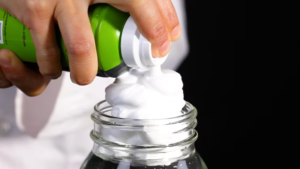
That distinction matters greatly in real-world formulations. Foam performance can depend on the surfactants selected, their concentrations, and how they interact with one another, as well as with the broader composition of the finished product. Removing sulfates may change one part of that equation, but it does not necessarily set a ceiling on foam.
With those test results in mind, what should formulators consider when developing a sulfate-free cleansing product?
1) Treat “Sulfate-Free” as a Formulation Parameter, Not a Performance Verdict
A sulfate-free claim can only tell consumers and formulators something specific about ingredient selection. It cannot, on its own, tell them how quickly a product will lather.
The Sufravon data results are a reminder that sulfate-free status alone cannot predict the foaming performance of a surfactant system. Even though SLS and SLES have long served as industry go-tos for foaming performance, they and other sulfates are not by any means the only way to produce sufficient foam.
Formulators must, therefore, consider sulfates just one of many options in surfactant selection. Rather than defaulting to established ingredients, the goal must always be to identify the surfactant system that best meets the product’s intended balance of foam, cleansing performance, mildness, and sensory feel.
2) Look at the Complete Surfactant System
While some ingredients can be key, the performance of the finished product still largely depends on how its ingredients work together. This makes ingredient compatibility an important consideration when building a sulfate-free system.
Natura describes Sufravon 868 as offering wide compatibility with different types of surfactants. This gives formulators room to fully optimize the system around the requirements of a particular application. This avoids the compromises that are often made when a single ingredient has to accomplish every performance objective.
3) Consider More Than Foam Height
Foam quality is highly visible to consumers, but it is only one of many other considerations in cleansing-product development. How effectively the formulation cleans and how it feels during use can matter just as much to the finished product, especially when it comes to gaining repeat purchases.
In any case, looking at a product’s properties together can help formulators avoid pursuing foam volume at the expense of the broader product experience. The objective is to create a surfactant system that meets the complete performance brief rather than optimizing a single measurement in isolation.
Sufravon 868 brings several properties into that broader performance equation. While it is mild and gentle, it still offers excellent foaming and cleansing properties. At the same time, it is a built-in moisturizer, providing formulators with yet another marketable benefit.
4) Know Where Sufravon 868 Fits
Sufravon 868 is a sulfate-free anionic primary surfactant with the INCI name Potassium Cocoate. Natura Aeropack offers it as an alternative to sulfate, SLS, and SLES, suitable as a primary surfactant in home cleansing formulations, including liquid laundry soap, liquid dishwashing soap, all-purpose cleaner, and degreaser.
Its formulation story also makes it much more than just a sulfate replacement. Sufravon 868 is 100% plant-based and has a 100% natural-origin calculation according to ISO 16128. It is readily biodegradable and made from coconuts, which can be grown sustainably. Its credentials also include COSMOS-Approved, Halal-Certified, Kosher-Compliant, vegan, and cruelty-free, making it suitable in an exceedingly wide range of products.
In practical terms, these attributes give formulators another way to think about sulfate-free development. Market-ready foam performance can remain a priority while ingredient origin, biodegradability, and other sustainability considerations are addressed within the same brief.
Put Sulfate-Free Foam to the Test
The takeaway from the data is simple: sulfate-free and low foam are not synonymous. Product performance ultimately depends on the surfactant chemistry and the system built around it, seldom on single ingredients. For formulators, this creates ample room to offer the foam body consumers desire while still meeting a sulfate-free product brief.
Ready to discuss your next formulation? Mark your calendar for in-cosmetics Asia, November 3–5, 2026 in Bangkok. Visit the Natura Aeropack team at Booth Y10, bring your sulfate-free product brief, and ask us about Sufravon 868 in person.